
How Google AI Overviews 2026 Are Killing Traditional SEO
In May 2026, some publishers have lost up to 70% of their organic traffic in a single year. Indeed, the cause is not a new algorithm or a Google penalty. Instead, it is Google AI overviews 2026. These AI-written summaries now sit on top of 48% of all Google searches. Google AI overviews 2026 are the short answers Google generates and pins to the top of the results page. They answer the user’s question directly. So the user never has to click a single link. Our team has watched client traffic shift in real time. Moreover, the shift is accelerating each quarter.
What Are Google AI Overviews 2026?
Google AI overviews 2026 are AI-generated summaries placed at the top of Google search results. They pull facts from many websites and answer the question right on the search page. Google launched them in 2024. By March 2026, they cover 48% of all queries.
Think of an AI overview as a robot reading 20 articles for you. Then it writes one short answer. As a result, the user gets what they need without clicking through. This is great for users. However, it is brutal for publishers.
People Also Ask boxes also appear next to 90% of AI overviews. That pushes blue-link results even further down the page. On mobile, where most searches happen, the real organic links sit below the fold.
How Are Google AI Overviews 2026 Killing Traditional SEO?
Google AI overviews 2026 cut organic click-through rates by up to 61% on triggered searches. One large field study found a 38% drop in outbound clicks. Zero-click search jumped from 54% to 72%. For some industries, the traffic drop runs even higher. Traditional SEO ran on clicks. Those clicks are vanishing fast.
Here is what we see in our client data. Pages that ranked first for years are still ranking first. However, their click-through rate has cratered. The position is the same. Visitors stopped showing up.
A study covering 68,000 real queries showed a 46.7% relative drop in clicks when an AI overview appeared. Another field study confirmed a 38% drop in outbound clicks on triggered queries. Indeed, for informational queries, the damage is worst. B2B technology pages see AI overviews on around 70% of searches. As a result, the old playbook of writing long blog posts to answer simple questions is collapsing fast.
Which Industries Lose Most to Google AI Overviews 2026?
Google AI overviews 2026 hit some industries far harder than others. B2B technology sees AI overviews on roughly 70% of queries. Health, finance, and education also take heavy hits. Meanwhile, e-commerce queries trigger AI overviews only 3 to 4% of the time. Buyers want product photos, prices, and reviews, not summaries.
Recent industry data shows the hardest-hit verticals. These include B2B tech, health, education, news, and how-to content. On these topics, Google can summarize an answer in three sentences.
However, e-commerce, local services, and high-intent transactional queries stay safer. For example, shoppers want to see product photos, prices, and reviews. AI overviews struggle with that kind of content.
So if your business sells information, you are in real trouble. If your business sells a product or a hands-on service, you have more breathing room. But do not get comfortable yet.
How to Survive Google AI Overviews 2026
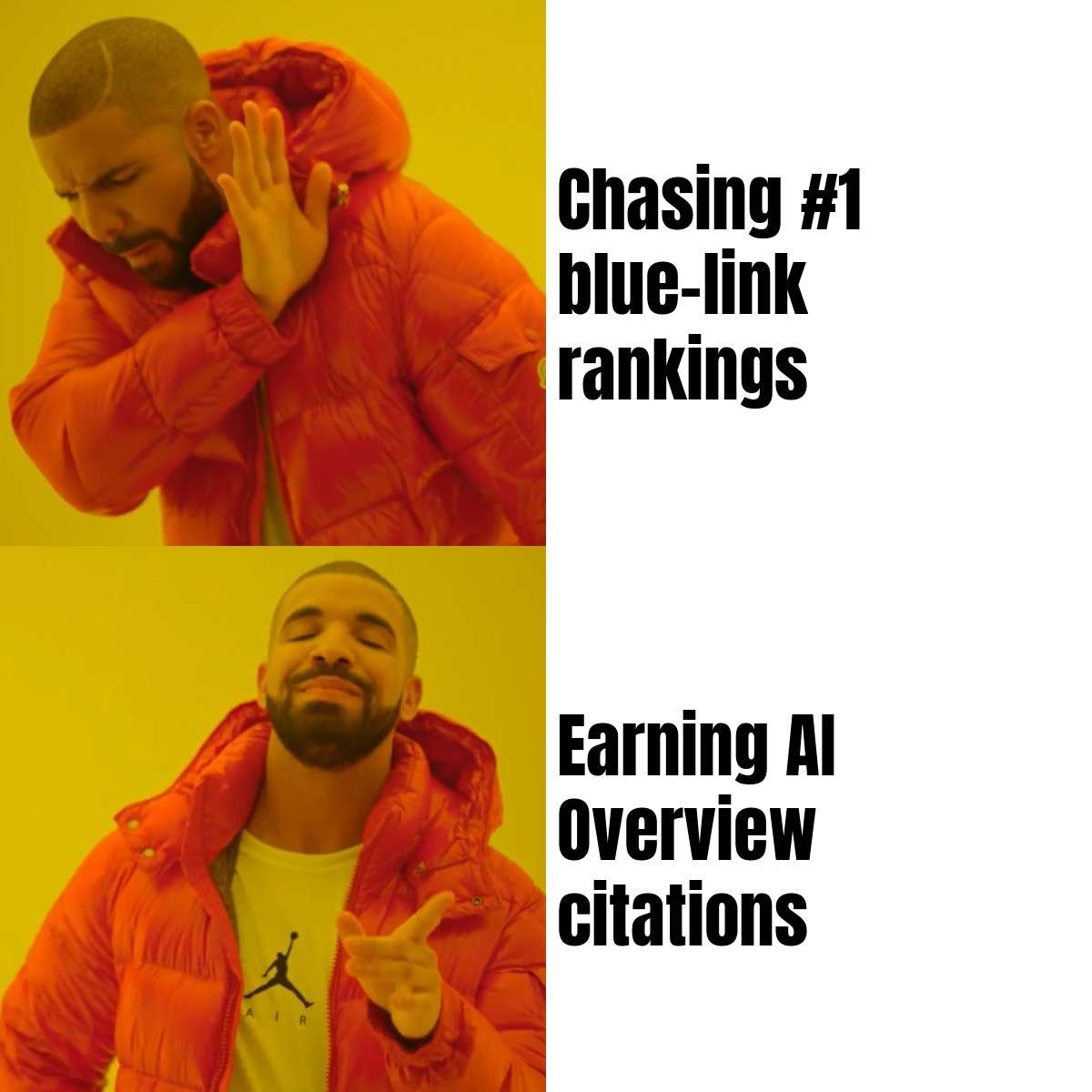
Google AI overviews 2026 force every brand to build channels that do not depend on Google. Diversify into paid ads, email, community, and brand. Then optimize content to be cited inside the AI overview itself. Cited brands earn 35% more organic clicks than non-cited brands on the same results page.
Here is the playbook our team runs with clients in May 2026.
First, accept the reality. Traditional SEO traffic is not coming back at past volumes. Therefore, plan for that new normal.
Second, diversify your traffic mix. Our team has helped clients scale memberships from zero to thousands of paying customers without leaning on Google. Our case study on scaling a membership from 0 to over 5,000 members breaks down the playbook. Paid social, email, and community did the heavy lifting there.
Third, write for citation, not for clicks. Put your direct answer in the first 150 words. Use clear H2 questions and add FAQ sections. Add schema markup so search engines understand your content. Furthermore, build content as self-contained units that AI engines can extract.
Fourth, invest in brand. A SparkToro analysis looked at 400 sites that held their traffic during the recent search shake-up. The survivors all had one thing in common. Each offered a unique product or service Google cannot replicate. Therefore, strong brand is no longer optional.
Fifth, get paid traffic right. Our breakdown of how to run profitable and scalable ads shows the two-lever framework we use. Reduce cost per acquisition. Then increase revenue per customer. Both levers compound over time.
Finally, study how to write for both humans and AI engines at once. The complete blog SEO guide from Ahrefs is a strong starting point for that work.
Frequently Asked Questions
Are Google AI Overviews 2026 replacing traditional SEO entirely?
Google AI overviews 2026 are not replacing SEO entirely. They are reshaping it. The keyphrase race for blue-link rankings is far less profitable now. SEO work must shift toward earning citations inside AI overviews. Building topical authority also matters more than ever. Pages cited in AI overviews still drive 35% more organic clicks than non-cited pages. So the goal changed, not the value of being visible.
How often do Google AI Overviews appear in 2026?
As of March 2026, Google AI overviews show up on roughly 48% of all tracked search queries. That number jumped from 34.5% in December 2025. Coverage varies a lot by topic. B2B technology and health content see AI overviews on around 70% of queries. Meanwhile, e-commerce queries trigger AI overviews only 3 to 4% of the time. So your exposure depends a lot on your niche.
What kind of content gets cited inside Google AI Overviews?
Content cited inside Google AI overviews shares a few traits. First, pages give direct answers in clean, short blocks. They use question-style headings and FAQ sections. They include structured data and schema markup. In addition, strong topical authority and clear E-E-A-T signals also help. Most importantly, the page reads like a self-contained answer block.
Will paid search ads also lose traffic because of AI Overviews?
Paid search is taking a hit as well. Recent industry data shows paid click-through rates fell roughly 68% on queries with AI overviews. However, Google now shows ads inside AI overviews on 25.5% of results, up from 5.17% in early 2025. So paid placements are changing fast. In fact, brands cited in AI overviews see 91% more paid clicks than non-cited brands on the same page.
The Bottom Line on Google AI Overviews 2026
Google AI overviews 2026 are not a small SEO update. They are a structural change to how the open web gets traffic. Pages still ranking first no longer get the same clicks they used to. Therefore, the web is shifting toward zero-click answers faster than most businesses are reacting.
The fix is not to fight the change. It is to build a business that does not depend on Google for free traffic. Diversify your channels. Build a brand worth following. Earn citations inside the AI overview. Invest in community, email, and paid acquisition.
Want help building a marketing engine that survives the next Google shift? Talk to our team at Growth of Influence today. We will audit your channel mix and show you where Google AI overviews 2026 already cost you traffic.


Join +6,000 influencers getting mindf*cked while reading The Influence Letter
(you may learn a bit about life & business too)
- [Article] How to spend profitably $300K on ads when you start with $100
- [Insight] Why an MBA Harvard Grad Partnered with me for Digital Marketing
- [Case Study] What happens when you message over 10,000 strangers
- [Training] How to manage your time when you’re paying for ads
- [Anti-Training] How I got scammed for $8.5K by marketers
- [Case Study] I spent 1 year in a €1K per month Mastermind
Enjoy, Grow, Influence
I create brands and projects to document the best methods to build an organization that stands the test of time.